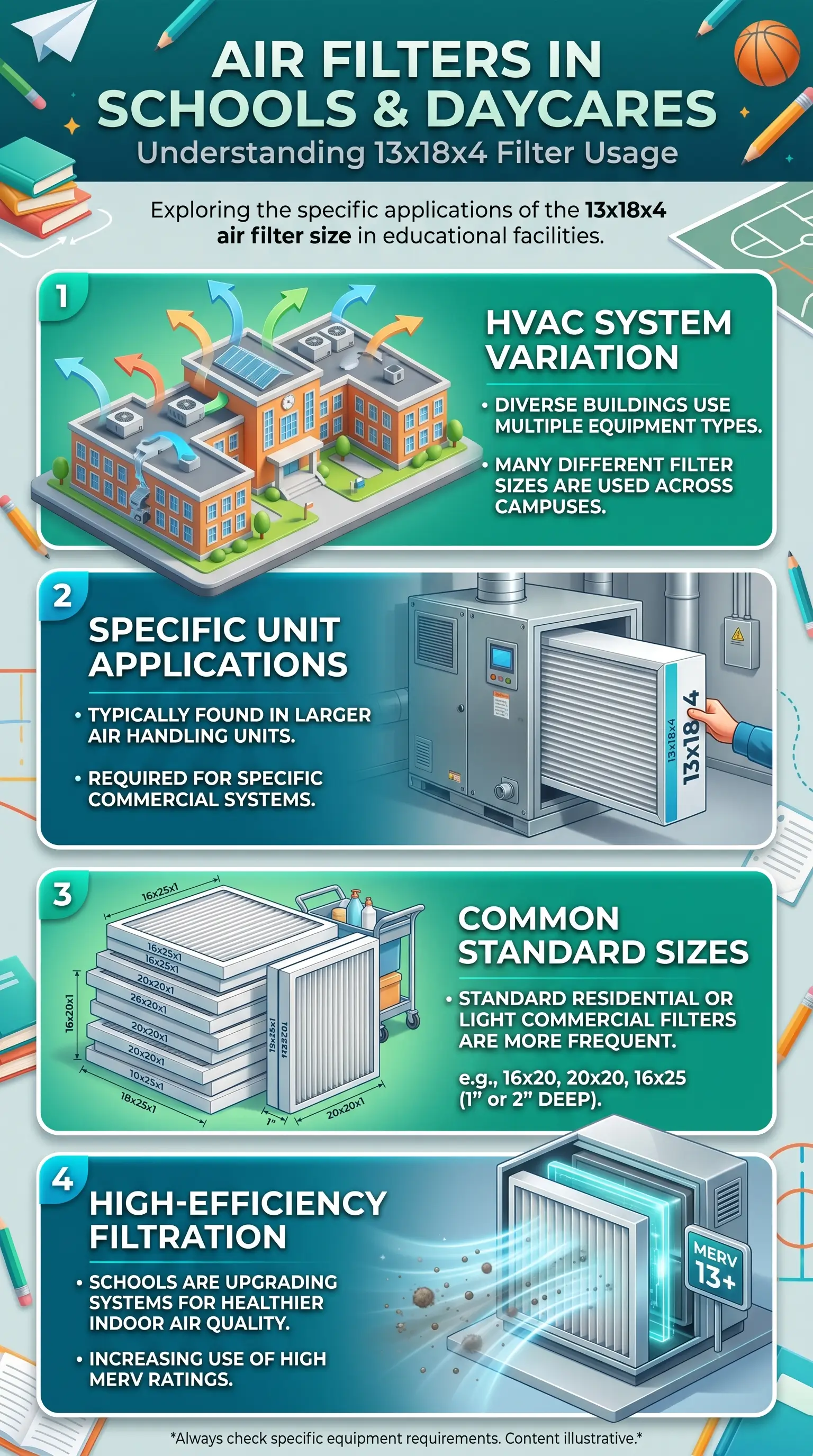
Most of the school and daycare HVAC returns our team measures here in Davie are built to hold a 13x18x4 air filter. A good number have a thinner filter stuffed in the cabinet instead, because that's what the last maintenance outfit left behind. So yes, schools and daycares across our area do use this size, and the difference between running the right one and the wrong one shows up quickly in how a classroom smells by Friday afternoon.
If your building already smells a little off by end-of-week, that's a signal worth listening to. Swapping in odor eliminator filters can help for a month or two, but when your HVAC is sized for a 4-inch cabinet, the longer-term fix is almost always a 13x18x4 at the right MERV rating.
TL;DR Quick Answers
Do schools and daycares use 13x18x4 air filters? Yes, many do, especially facilities with commercial HVAC systems.
Is it a common size? It's semi-custom, so you'll see it in commercial equipment but rarely in retail stores.
What MERV rating is best for kids? MERV 13, the rating the CDC and ASHRAE both recommend.
How long does it last? In a typical Davie classroom, 6 to 9 months between changes.
Where to source it in Davie? Direct from an American manufacturer, since local stores rarely carry this size.
Top Takeaways
Yes, many Davie-area schools and daycares do use 13x18x4 air filters, especially those with commercial or semi-custom HVAC systems.
The 4-inch depth gives the pleats more surface area, so filters last 6 to 9 months instead of 30 days.
MERV 13 is the minimum rating the CDC and ASHRAE recommend for spaces where children gather. See MERV 13 vs 8 for a side-by-side of what each tier actually catches.
Always measure the HVAC return before upgrading. A 4-inch filter in a 1-inch slot will damage the blower.
If a facility can't source the 13x18x4 size locally, a trusted American manufacturer can custom-fit and ship direct. We recommend high-quality 13x18x4 air filters from Filterbuy for that reason.
The 13x18x4 size isn't something you'll find in a hardware store aisle. It's a 4-inch deep pleated filter built for commercial and semi-custom HVAC returns. You'll see it tucked into rooftop units at local elementary schools or above the ceiling tiles at privately run preschools. Because it sits deeper than a thinner size option most homes use, the pleats have much more surface area to trap pollen, dust, mold spores, and virus-carrying droplets drifting through a classroom with 20+ kids in it.
For a closer look at how mechanical filtration works on a scientific level, the encyclopedia entry on air filter is a good starting point. What matters in a daycare or school is simpler. Schools and daycares running 13x18x4 filters get better filtration for sensitive young lungs, longer gaps between changes so maintenance doesn't interrupt class time, improved airflow through older HVAC systems that still have life in them, and a real shot at steady indoor air quality through a South Florida summer.
Why the 4-inch depth matters for classrooms
In a busy classroom, your maintenance crew has to swap a 1-inch filter every 30 to 60 days. The same room running a 13x18x4 can go 6 to 9 months between changes, sometimes longer across summer break. For facilities without the cabinet depth for a full 4-inch filter, a 2-inch pleated option sits roughly in the middle. That math favors the 4-inch. You get fewer filter swaps during the school day, lower annual labor costs, steadier filtration between service visits, and less strain on HVAC equipment that pulls in South Florida humidity every day of the year.
Where the size shows up locally
From our service calls across Davie, Cooper City, Plantation, and the rest of Broward County, the 13x18x4 shows up most often in packaged rooftop units, custom return grilles that sometimes also need duct repair guidance, and HVAC equipment installed or retrofitted between the mid-1990s and the mid-2010s. It often sits right next to a popular furnace size like 16x25x1 in older residences that have been converted for business use. A lot of daycares here operate out of those converted homes or small commercial spaces. They inherited the HVAC as-is when they moved in, and most of them never got a walk-through of what the equipment was actually built to hold.
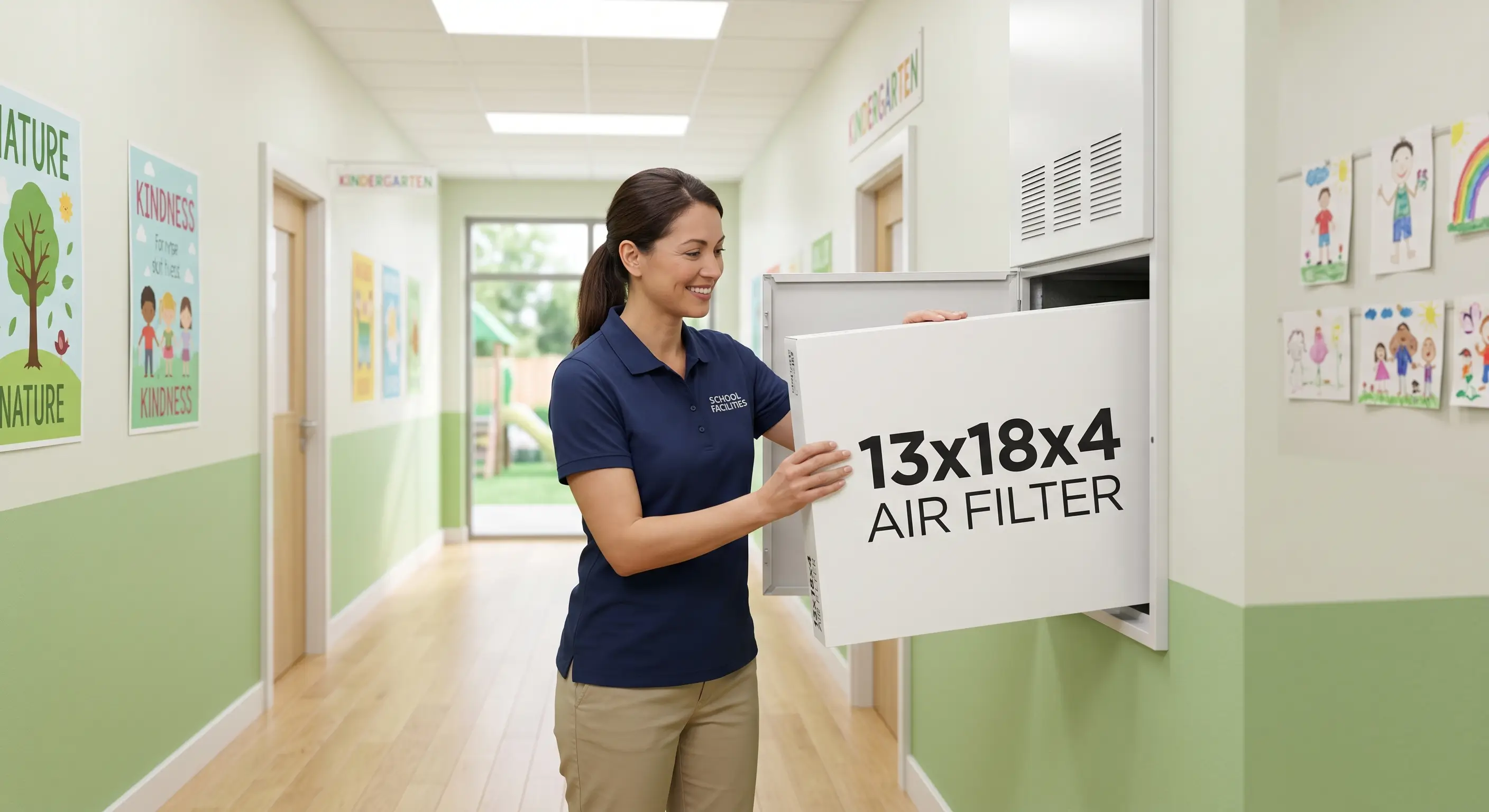
“After years of crawling through South Florida attics and rooftops, the pattern we see most often is a Davie daycare or school running HVAC perfectly sized for a 4-inch filter, but with a 1-inch filter stuffed in the cabinet because that's what the last crew had on the truck. Swapping in the correct 13x18x4 at MERV 13 is one of the highest-impact, lowest-cost changes any local facility can make for the kids' air.”
— Filterbuy HVAC Solutions Field Team, South Florida (Licensed, insured, and living in the community we serve.)
7 Essential Resources
These are the authoritative, non-commercial sources we hand to facility managers when they want to dig deeper. Every link below is from a unique domain (government, academic, or non-profit) with no competing HVAC retailers in the mix.
EPA, Indoor Air Quality Tools for Schools: www.epa.gov/iaq-schools. This is the framework tens of thousands of U.S. schools use to build their IAQ management programs.
CDC, Ventilation FAQs (NIOSH): www.cdc.gov/niosh/ventilation/faq. Plain-language guidance on MERV 13, air changes per hour, and HVAC filtration for shared indoor spaces.
U.S. Department of Education, Improving Ventilation in Schools: www.ed.gov/.../covid-19/ventilation. Federal guidance written specifically for K-12 facility managers on filter upgrades and HVAC improvements.
ASHRAE, Reopening of Schools and Universities Guidance: www.ashrae.org. Technical recommendations from the engineering society, including MERV 13 minimums and Standard 241 for infectious aerosol control.
American Lung Association, Asthma Trends Brief: www.lung.org/research/trends-in-lung-disease/asthma-trends-brief. Demographic data on childhood asthma that facility managers use to make the case for better filtration.
Harvard T.H. Chan School of Public Health, Healthy Buildings for Schools: healthybuildings.hsph.harvard.edu. Peer-reviewed strategies on classroom ventilation, filtration, and clean-air changes per hour.
Efficient Healthy Schools (Lawrence Berkeley National Lab / DOE): efficienthealthyschools.lbl.gov. National-lab-backed guidance on aligning CDC and ASHRAE recommendations for real-world school HVAC.
3 Statistics
These numbers give you a sense of why filter choice matters more than it sounds.
6.5% of U.S. children under age 18 currently live with asthma. That works out to roughly 1 in every 15 kids in a Davie classroom already managing a respiratory condition that airborne particles can set off. Source: CDC FastStats on Asthma.
Indoor air pollutant levels can run 2 to 5 times higher than outdoor levels, and sometimes over 100 times higher. Most people spend about 90 percent of their time indoors, which is why that concentration matters so much inside a school building. Source: EPA Reference Guide for Indoor Air Quality in Schools.
MERV 13 filters are at least 85% efficient at capturing particles in the 1 to 3 micrometer range. That covers most respiratory droplets, dust mite debris, mold spores, and the fine airborne junk kids encounter indoors every day. Source: CDC Ventilation FAQs.
Final Thoughts and Opinion
Honest take, neighbor to neighbor. Most schools and daycares in Davie are doing their best with whatever HVAC setup they inherited. They're not ignoring air quality on purpose. They just don't have someone walking them through what their system was actually built to handle. When we open up returns in local facilities, we regularly find equipment sized for a 13x18x4 running a cheaper, thinner filter that wears out every 30 days and doesn't catch what matters most.
Upgrading to a 4-inch filter at MERV 13 isn't a luxury. The CDC, EPA, and ASHRAE all point this direction for spaces where children gather. It protects the HVAC equipment and the kids inside the building at the same time, and it helps cut energy costs by running the HVAC less hard, which typically saves the facility money inside the first year. If the equipment itself is near end-of-life, our HVAC replacement guide for Davie homes and facilities walks through the next steps. We'd rather see every local classroom running the right filter than watch another asthma-triggered school day happen in our own backyard.
Frequently Asked Questions
Is 13x18x4 a standard air filter size?
It's a semi-custom size. You won't find it in most big-box stores, but it's common in commercial HVAC equipment and available direct from U.S. manufacturers. If your local hardware store doesn't stock it, that's normal. For a full size guide covering common and semi-custom dimensions, a dedicated size reference is the easiest way to confirm what you need.
Do all Davie schools use this exact filter size?
No. The filter size depends entirely on the HVAC equipment installed at each facility. Some use 16x25x4, 20x20x4, an 18x20x1 alternative size, or fully custom dimensions. Always measure your return or check the filter cabinet label before ordering.
Can an older HVAC system handle a 4-inch filter?
Most systems can, as long as the cabinet is sized for 4 inches. Forcing a 4-inch filter into a slot built for a 1-inch filter restricts airflow and strains the blower motor. Have an HVAC technician confirm compatibility first. It's a 5-minute measurement.
What MERV rating should a daycare use?
MERV 11 is a practical minimum, and MERV 13 is ideal when the system can support it. If you want MERV 11 explained in more depth, that link walks through it. Some HVAC pros push back on a blanket MERV 13 recommendation, and it's fair to hear them out on the MERV 13 tradeoffs before locking in a choice. For daycares with kids who are sensitive to pollen, specialized allergen defense filters in the MERV 11 range are also worth a look.
How often do 13x18x4 filters need to be replaced in a school?
In most Davie-area schools and daycares, every 6 to 9 months works well. Plan for shorter intervals during peak allergy season from February through May, and longer ones across summer break when occupancy drops. Watch for clogged filter signs as the most reliable indicator it's time to swap.
Ready to Check Your Facility's Air?
If you run a school, daycare, or any children's facility in Davie, FL, or anywhere across Broward County, stop guessing about the air your kids are breathing. Our local Filterbuy HVAC Solutions team will come out, measure your return, check your current filter against what your HVAC system was actually built to use, and give you honest, no-pressure recommendations. We live here too. Your kids' air quality is our kids' air quality.
Schedule a free indoor air quality assessment today, or order American-made 13x18x4 air filters direct from Filterbuy and have them shipped straight to your facility. When a facility manager needs them faster, a major retailer option or a marketplace listing option can work in a pinch. Cleaner classroom air starts with the right filter, and we'll help you find it.
So take the next step. Request a free IAQ assessment, order 13x18x4 filters direct from the manufacturer, or call our local Davie team for a no-pressure conversation with neighbors who happen to be HVAC pros.
Learn more about HVAC Care from one of our HVAC solutions branches…
Filterbuy HVAC Solutions - Miami FL - Air Conditioning Service
1300 S Miami Ave Apt 4806 Miami FL 33130
(305) 306-5027
https://maps.app.goo.gl/Ci1vrL596LhvXKU79